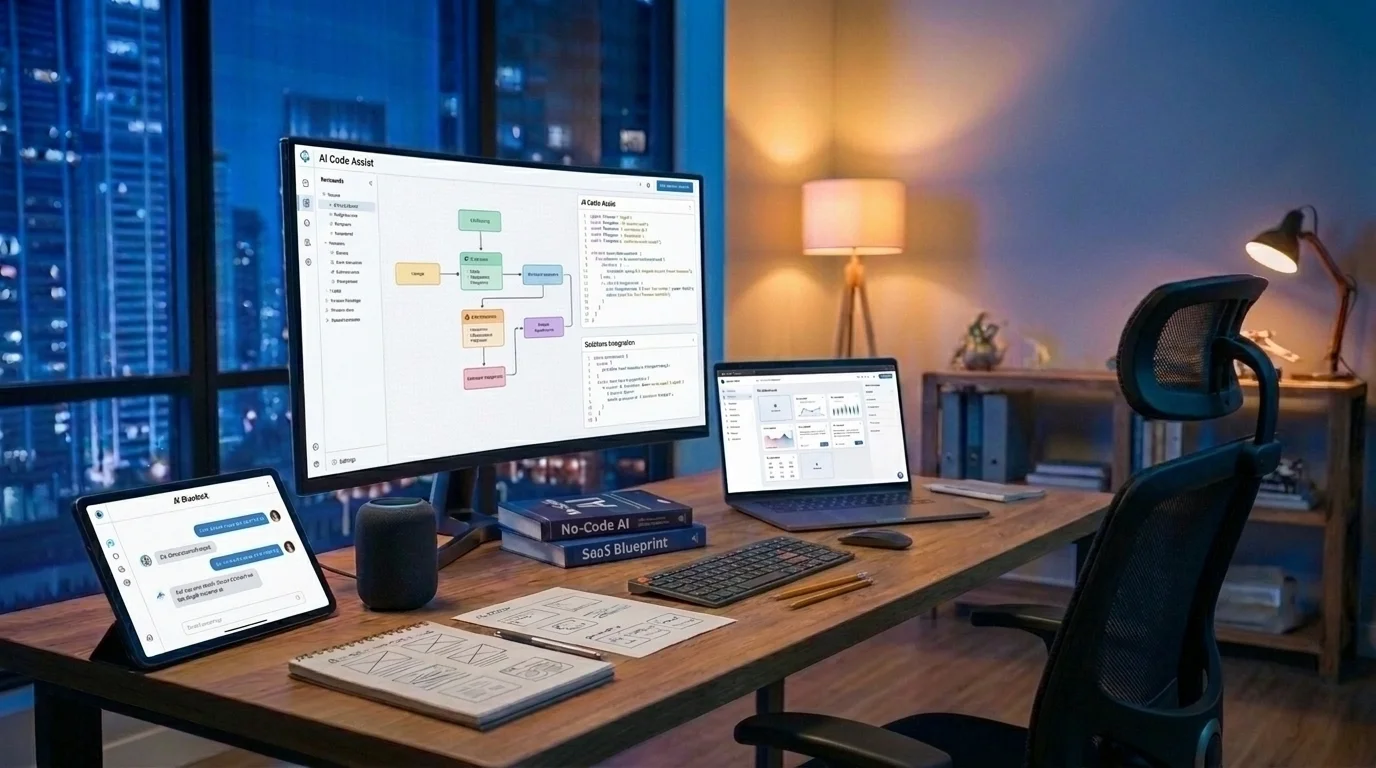
A few years ago, launching a software product meant hiring developers, waiting months, and spending a large budget before a single customer signed up. Today, you can type a prompt into an AI app builder and watch a working dashboard appear in minutes. That shift has many founders and business owners asking the same question: can AI build a SaaS product without coding?
The honest answer is yes, but only up to a point. AI and no-code tools can take you surprisingly far, especially in the early stages. However, there is a clear line between a working prototype and a secure, scalable product that paying customers trust.
In this guide, we break down what AI can actually do, where it struggles, and how real businesses use these tools wisely. We also share a practical plan you can follow and explain when it makes sense to bring in a professional team.
The Short Answer: Can AI Build a SaaS Product Without Coding?
AI can build a functional SaaS MVP (minimum viable product) without you writing a single line of code. With the right tools, a non-technical founder can create:
- User sign-up and login screens
- A database to store customer information
- Dashboards, forms, and reports
- Basic payment flows through tools like Stripe
- Automated emails and workflows
That is a real achievement, and it changes how startups test ideas. Still, "working" and "ready for growth" are not the same thing. Once you have hundreds or thousands of users, sensitive data, and complex business rules, the gaps start to show.
Think of AI as a very fast junior assistant. It builds quickly, follows instructions, and handles common patterns well. However, it does not fully understand your business, your users, or the long-term risks behind every technical decision.
What AI and No-Code Tools Can Actually Do Today
To answer whether AI can build a SaaS product without coding, it helps to understand the different types of tools available. Each one solves a different part of the puzzle.
AI App Builders That Turn Prompts Into Apps
Tools like Lovable, Bolt, and Replit's AI agent let you describe an app in plain English. For example, you might type: "Build a client portal where coaches can track session notes and send invoices." Within minutes, you get screens, a database structure, and basic logic.
These tools are excellent for:
- Testing an idea quickly
- Showing investors or partners a clickable demo
- Building internal tools for a small team
Visual No-Code Platforms
Platforms such as Bubble, Softr, Glide, and FlutterFlow use drag-and-drop editors. You build pages visually, connect data, and set up actions without code. Many of these now include AI features that generate layouts or logic for you.
No-code SaaS platforms work well when your product follows common patterns, like marketplaces, directories, booking systems, or simple CRMs.
Automation Tools
Automation tools like Zapier, Make, and n8n connect different apps together. For instance, when a new user signs up, an automation can add them to your email list, create a record in Airtable, and notify your team on Slack.
These tools act as the "glue" behind many no-code products. They save hours of manual work, especially in the early days.
AI Design and Content Assistants
AI can also help with design mockups, onboarding copy, help center articles, and even marketing emails. As a result, a small team can produce a lot more material than before.
Where AI Falls Short When Building a SaaS Product
Now for the part that most "build an app in 10 minutes" videos skip. The limits of AI app development matter a lot once real customers depend on your product.
Security and Data Protection
Security is the biggest concern. AI-generated apps often have weak spots, such as exposed API keys, poor access controls, or databases that anyone can read with the right link. Many founders do not notice these issues until something goes wrong.
If your SaaS handles personal data, payments, or health information, you need to follow proper security practices. The OWASP Top Ten is a widely respected list of the most critical web application risks, and AI-built apps can fall into several of them. You may also need to meet privacy laws like GDPR if you serve European users.
Complex Business Logic
AI handles simple rules well. "If a user pays, unlock premium features" is easy. But real businesses have messy rules. Consider a staffing platform that calculates pay based on shift type, overtime, location, client contract, and holiday rates. AI tools often produce logic that works in testing but breaks in edge cases.
Scalability and Performance
A no-code app that runs smoothly with 50 users may slow down badly with 5,000. Furthermore, many no-code platforms charge based on usage, so costs can rise quickly as you grow. Business scalability requires careful database design, caching, and server planning that AI tools rarely get right on their own.
Code Ownership and Vendor Lock-In
With many no-code platforms, you do not truly own your code. If the platform raises prices, changes features, or shuts down, moving your product elsewhere can be painful. Some AI builders let you export code, but that code is often hard for developers to maintain.
Maintenance and Debugging
When something breaks in an AI-built app, fixing it can be tricky. You might ask the AI to fix one bug, only for it to create two new ones. Without technical knowledge, founders often get stuck in a loop of prompts and patches.
Real Business Examples: When No-Code SaaS Works and When It Doesn't
Theory is useful, but real scenarios make the picture clearer. Here are three examples based on situations we see often.
Example 1: The Fitness Coach Who Validated Fast
A personal trainer wanted to sell a monthly subscription for workout plans and progress tracking. She used an AI app builder and Stripe to launch a simple SaaS MVP in two weeks. Within three months, she had 120 paying members.
Why it worked: The product was simple, the data was not highly sensitive, and the goal was product validation, not perfection.
Example 2: The Logistics Company That Outgrew Its Tools
A regional delivery company built a driver-tracking dashboard with a no-code platform. It worked well at first. However, as they added more drivers, real-time location updates slowed the app down, and monthly platform fees tripled.
What they did next: They moved to a custom-built system with a proper backend and a dedicated mobile app for drivers. The no-code version was not wasted, because it showed exactly which features mattered most.
Example 3: The HR Consultant With a Compliance Problem
An HR consultant used AI to build a tool that stored employee records for small business clients. A client's IT team reviewed it and found that files were accessible without proper login checks.
The lesson: When your SaaS handles sensitive data, AI alone is not enough. Professional security review and custom software development become essential.
How to Build a SaaS MVP With AI Without Coding: A Step-by-Step Plan
If you want to test an idea using AI and no-code tools, follow this practical process. It keeps your risk low and your learning high.
- Define one clear problem. Write down the exact problem you solve and who has it. Avoid trying to serve everyone.
- Validate demand before building. Talk to at least 10 to 20 potential customers. The Y Combinator Startup Library is a strong resource for early-stage founders thinking through this step.
- List your core features. Pick only the three to five features users truly need. Everything else can wait.
- Choose the right tool. Use AI app builders for quick prototypes, visual platforms for more control, and automation tools for workflows.
- Build a simple version. Focus on the main user journey from sign-up to the "aha" moment.
- Test with real users. Watch how people use it. Note where they get confused or drop off.
- Collect feedback and track data. Measure sign-ups, active users, and conversions.
- Decide your next move. If demand is strong, plan for a stable, secure, and scalable version.
This approach helps you avoid the common trap of building something nobody wants before you have confirmed real demand.
When Should You Move From No-Code to Custom Software Development?
Many founders wonder when it is time to move beyond AI tools. Here are clear signs that your product needs professional development:
- You are gaining paying customers and cannot afford downtime
- Your app is slowing down as users increase
- Platform costs are rising faster than your revenue
- You handle sensitive data like payments, health records, or personal details
- You need custom integrations with tools your platform does not support
- Investors are asking about your tech stack and code ownership
- Bugs keep returning no matter how many times you fix them
At this stage, custom software development gives you full control, better performance, and a product you truly own. Additionally, many SaaS products eventually need a mobile version. Customers expect to log in from their phones, especially for tools they use daily. Professional mobile app development ensures your app feels fast and native on both iOS and Android.
Why UI/UX Still Matters When AI Builds Your SaaS Product
AI can generate screens, but it cannot fully understand your users. Many AI-built apps look fine at first glance but feel confusing in practice. Buttons sit in odd places, onboarding is unclear, and key actions are buried in menus.
Good UI/UX design directly affects whether users stay or cancel. In SaaS, where revenue depends on monthly renewals, poor usability quietly drains your income.
Here is what strong UI/UX brings to a SaaS product:
- Clear onboarding that helps users reach value quickly
- Simple navigation so people find features without help
- Consistent design that builds trust and looks professional
- Accessible layouts that work for a wider range of users
Our UI/UX design services focus on exactly these areas. Poor design is one of the most common reasons users cancel, and it is often fixable with a proper design review before launch.
Building the Product Is Only Half the Job
Even if AI can build a SaaS product without coding, it cannot find customers for you. Many founders launch a decent product and then hear nothing but silence. Growth requires a clear plan to attract, convert, and keep users.
A Website That Sells Your SaaS
Your marketing website is often the first thing prospects see. It needs to explain your value in seconds, load fast, and guide visitors toward a free trial or demo. Professional web design and development makes this possible, and it keeps your marketing site separate from your app for better speed and SEO.
Digital Marketing Channels That Drive Sign-Ups
Different channels work for different stages of growth:
- SEO brings steady, long-term traffic from people searching for solutions. Our SEO services help SaaS brands rank for high-intent keywords.
- PPC advertising delivers faster results and helps you test messaging quickly without waiting months for organic traffic.
- Social media marketing builds awareness and community, keeping your brand visible where your audience spends time.
eBooks as Lead Magnets
Many successful SaaS companies use free guides to capture leads. For example, a project management SaaS might offer an eBook titled "The Small Agency Guide to Managing Client Projects." Visitors trade their email for the guide, and your team nurtures them toward a trial. A well-designed eBook makes your brand look polished and credible from the start.
The Smart Approach: Combine AI Speed With Expert Development
The best path for most businesses is not "AI only" or "developers only." Instead, it is a hybrid approach that uses each where it fits best.
Here is how that often looks in practice:
- Use AI and no-code tools to validate your idea quickly and cheaply.
- Gather real feedback from early users to learn what truly matters.
- Bring in a professional team to design a strong user experience and build a secure, scalable version.
- Keep using automation tools for internal workflows where they save time.
- Invest in marketing to grow your user base steadily.
This method saves money, reduces risk, and gets you to a stable product faster. It also means your final product is built on proven demand rather than guesswork.
Developers themselves now use AI tools to speed up coding, testing, and documentation. So the real question is not "AI or humans?" It is "How do we use AI wisely, with expert guidance?"
How Razen Creations LLC Helps You Build a SaaS Product That Lasts
At Razen Creations LLC, we work with founders and business owners at every stage of their SaaS journey. Some come to us with only an idea. Others arrive with an AI-built prototype that is starting to crack under pressure.
Here is how we typically help:
- Reviewing your no-code or AI-built MVP to spot security, performance, and design issues
- Planning the right tech stack based on your goals and budget
- Designing intuitive interfaces that keep users engaged
- Building custom web and mobile apps you fully own
- Launching marketing campaigns that bring in qualified sign-ups
Have a SaaS idea or a prototype that needs to grow up? Contact our team to get a free consultation. We will give you an honest assessment of what your current setup can handle and what it needs next.
Final Thoughts
So, can AI build a SaaS product without coding? It can build a working starting point, and that alone is a big deal for founders with limited budgets. AI and no-code tools are excellent for validating ideas, building internal tools, and launching simple products quickly.
However, a lasting SaaS business needs more than a prototype. It needs strong security, smart architecture, thoughtful design, and a steady flow of customers. That is where experienced developers, designers, and marketers make the difference.
Use AI to move fast. Then, when your idea proves itself, build it properly. If you want a partner for that next step, work with Razen Creations LLC and turn your early success into a product built to scale.
Frequently Asked Questions
1. Can AI build a SaaS product without coding from start to finish?
AI can build a basic SaaS MVP with features like user accounts, dashboards, and payments. However, it usually cannot handle advanced security, complex business logic, or large-scale performance without help from experienced developers.
2. What are the best no-code tools for building a SaaS MVP?
Popular choices include Bubble and FlutterFlow for visual building, Lovable and Bolt for AI-generated apps, Airtable or Supabase for data, Stripe for payments, and Zapier or Make for automation. The best tool depends on your product type and goals.
3. Is a no-code SaaS product secure enough for real customers?
It can be for simple use cases, but many AI-built and no-code apps have hidden security gaps. If you store personal, financial, or health data, you should get a professional security review before launch.
4. How much does it cost to build a SaaS product with AI?
A no-code SaaS MVP can cost anywhere from a few hundred to a few thousand dollars in tools and subscriptions. Costs rise as you add users and features. Custom development costs more upfront but often saves money long term.
5. When should I switch from no-code to custom software development?
Consider switching when you have steady paying customers, your app slows down, platform fees climb, or you need features and integrations your tool cannot support. Investor interest is another common trigger.
6. Can I convert my AI-built prototype into a custom app?
Yes. Your prototype is valuable because it shows which features users actually want. A development team can use it as a blueprint to build a secure, scalable version with clean code you fully own.
7. Does Razen Creations LLC help with SaaS products built using AI?
Yes. Razen Creations LLC reviews AI-built and no-code products, improves UI/UX, rebuilds apps with custom development, and supports growth through SEO, PPC, and social media marketing. Get a free consultation to discuss your project.